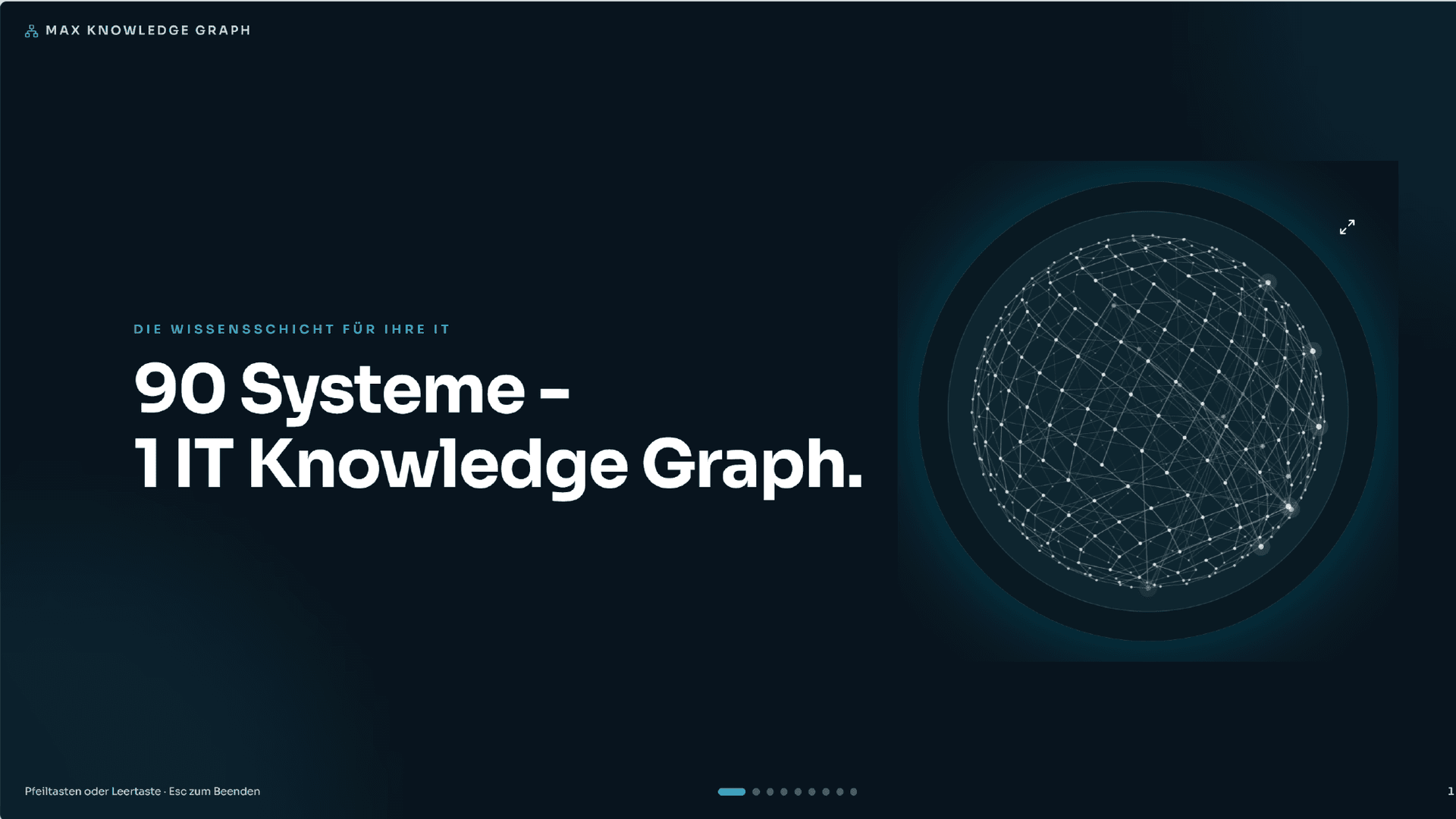
The complete presentation from the webinar on 14 July 2026 — "Webinar to go" and thus a sound basis for internal coordination with IT management, security, compliance and other stakeholders.
What the slides contain
The slides show how isolated systems become a shared context: connectors bring together identities (Active Directory, Entra ID, IAM), collaboration (Microsoft 365, Teams, SharePoint), files and rights (file servers, NAS, NTFS) as well as operations and security (HR, ITSM, SIEM) in a single knowledge layer.
A dedicated section explains why a Knowledge Graph and not a relational database is used for this: in SQL, relationships only come into being in the query and have to be reassembled for every new question. In the graph, relationships are part of the model — they are directly visible, traversable and reusable for new questions.
From data inventory to decision
It closes with the three steps that turn knowledge into action:
- Detect — find conspicuous access, risky roles and missing responsibilities.
- Assess — evaluate affected systems, impact and urgency in context.
- Correct — clear correction instructions with the appropriate next step.