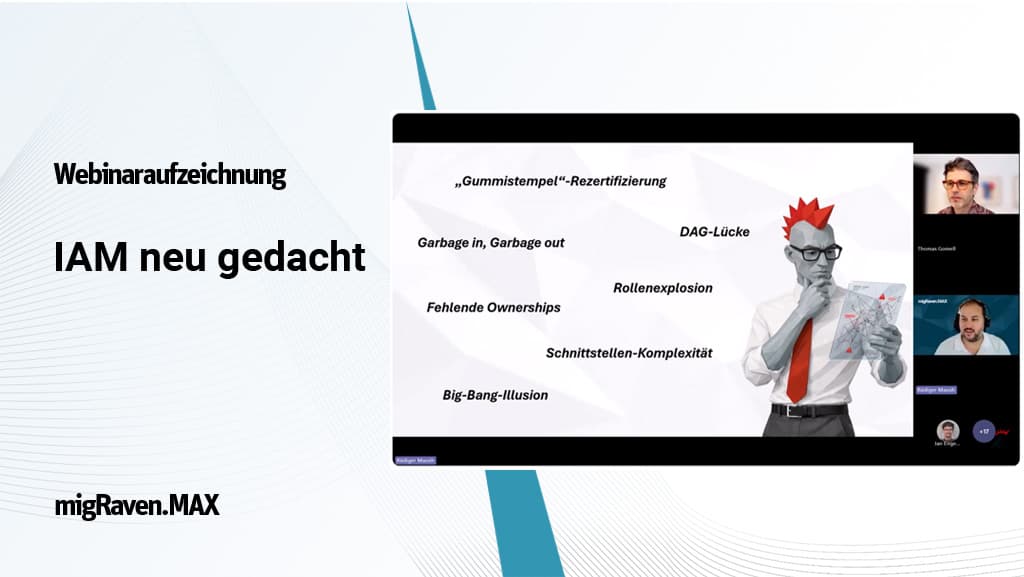
Traditional IAM systems promise clear roles, automated processes and greater security. In practice, however, many projects fail because of a reality that is rarely documented cleanly: historically grown IT structures, unclear responsibilities, complex permissions, orphaned accounts and systems whose actual effect hardly anyone can still fully oversee.
This is exactly where migRaven.MAX comes in. MAX is not simply another IAM system, but a platform that makes identities, permissions, data structures, system resources, cloud information and compliance requirements visible in a shared context. The distinctive approach: MAX combines traditional IAM functions with data access governance, a comprehensive knowledge graph and AI-supported analysis.
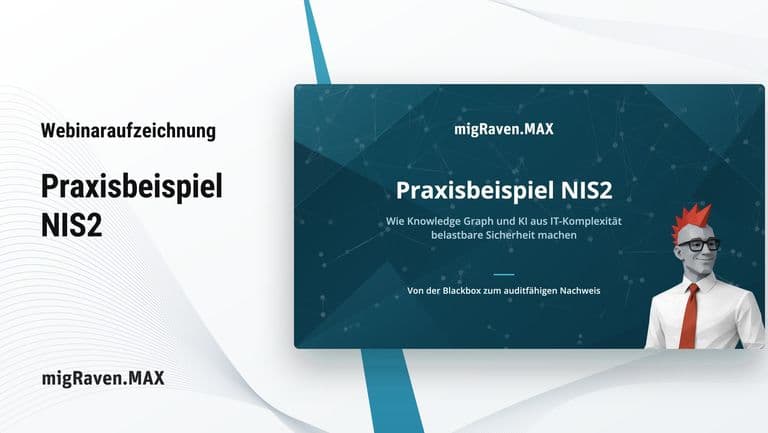
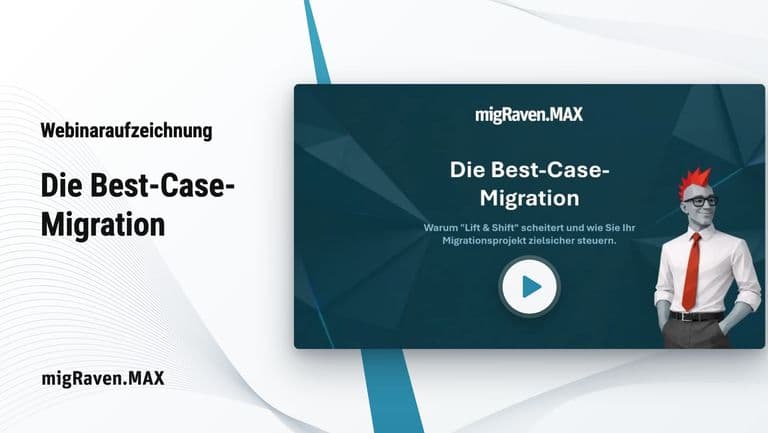
Webinar recording: IAM rethought with migRaven.MAX
Why traditional IAM projects often fail to deliver what they promise
Many companies start IAM projects with a clear goal: processes are to be automated, roles cleanly defined and permissions managed more securely. In reality, however, these projects frequently run into a fundamental problem: the existing IT landscape is not structured the way it would actually have to be for a traditional role model.
Active Directory structures grown over years or decades, file server permissions, local groups, cloud accounts, SaaS applications, service accounts and group policies form a web that is difficult to translate into simple roles, profiles or personas. What begins on paper as a clean IAM concept quickly becomes a very laborious maintenance project during implementation.
The underlying problem of many IAM projects
An IAM system can only work as well as the understanding of the structures it is built on. If groups, permissions, data areas, system accounts and responsibilities are not traceable, even the best role model quickly becomes questionable.
Role models meet a reality that has grown over time
Traditional IAM solutions are strongly geared towards controlling identities through defined roles and processes. This approach makes sense in principle, but it becomes difficult when the real environment cannot be mapped cleanly onto a few stable roles. In practice, a great many special cases, exceptions and follow-up maintenance tasks then arise.
It becomes particularly problematic when organizations, applications and responsibilities change continuously. Roles, profiles and personas then have to be maintained on an ongoing basis. If that does not happen, the IAM system gradually loses its reliability.
Too many legacy burdens
Orphaned accounts, unused groups, old permissions and historically grown folder structures often remain in place because no one can say with certainty what effects a change would have.
Too little context
Individual objects can be analyzed, but their relationship to data, systems, group policies, applications or cloud services often remains unclear.
Too much maintenance effort
An IAM system requires clear processes, defined owners and continuous maintenance. If this effort is underestimated, role models quickly lose quality.
MAX takes IAM further: identities, data and systems in context
migRaven.MAX was developed to close this gap. The approach goes well beyond traditional identity & access management. MAX looks not only at user accounts and group memberships, but also at the systems these identities act on.
These include, among others, Active Directory, Entra ID, file servers, SharePoint, Teams, local servers, group policies, software installations, service accounts, licenses, roles, mailboxes and further technical as well as organizational information. This data is not viewed in isolation but brought together in a shared knowledge graph.
The distinctive approach of MAX
MAX combines IAM, data access governance, analysis, Clean-up, ownership and compliance in one platform. This creates a more complete picture of the IT reality: who has access? What does this access affect? Which objects are still needed? Where do risks arise? And which measures make sense?
The result: Companies gain not just an administration interface, but a solid basis for decisions on security, clean-up, auditing and automation.
Why a purely IAM-focused view is no longer sufficient
Modern IT environments have long since ceased to consist of a single local domain. Cloud services, hybrid identities, SaaS applications, shared data areas, external guests, Teams and SharePoint shares as well as non-human identities increase complexity considerably.
An IAM system that only manages identities therefore sees just one section of the picture. MAX extends this view with the context needed for real security decisions: data, permissions, technical dependencies, system objects and responsibilities.
The knowledge graph as the basis for transparency
The central building block of MAX is the knowledge graph. It relates information from different sources to one another and thereby makes connections visible that often remain hidden in traditional database or report structures.
Instead of placing individual lists or static reports side by side, a connected model of the IT environment emerges. This makes it possible to trace which groups are used where, which permissions act on data, which accounts are connected to systems and which objects may no longer serve any purpose.
Analysis
MAX collects technical and organizational information from different systems and makes it centrally analyzable.
Context
Objects are not viewed in isolation but placed in relation to identities, data, groups, applications and policies.
Decision
The analysis provides concrete pointers for Clean-up, role definition, risk assessment, migration, recertification and auditing.
AI in MAX: not a chat window, but context-based analysis
In MAX, AI is not an isolated add-on feature. It works on the basis of the information in the knowledge graph. That is decisive: while general AI systems without knowledge of the specific environment can only give generic answers, MAX can answer questions in the context of the actual IT structure.
This turns the AI into a tool that explains complex structures, assesses anomalies, generates reports, prepares action plans and supports the development of concepts. The quality of the answer results not only from the language model, but from the specific data context of your own environment.
MAX makes complexity explainable
The AI can, for example, analyze GPO settings, assess their effect on a tiering model, explain Active Directory structures, name anomalies or generate individual audit reports. What is decisive: the answer refers to your own environment, not to an abstract best-practice description.
From the static report to the individual question
In traditional systems, companies often have to rely on predefined reports. These do deliver information, but they do not automatically answer the specific question that is currently relevant in the project. MAX takes a different route here: the analysis can be carried out as the situation requires.
An IT manager may need a security assessment. An administrator wants to know which groups are still in use. A CISO asks about risks. A project manager needs a basis for a migration. MAX can serve these different perspectives because the information is brought together in the knowledge graph and becomes analyzable through AI.
Clean-up as a prerequisite for effective IAM
A central topic of the webinar is the clean-up of existing structures. Because anyone who places an IAM system on top of uncleaned, unclear and historically grown structures carries their problems over into the new process world.
MAX therefore supports not only administration but also tidying up. This includes processes for Active Directory, groups, users, cloud guests, external shares, file server permissions, SharePoint structures, orphaned ACEs and obsolete data.
Typical Clean-up questions that MAX supports
- Which groups are still in use?
- Which accounts are orphaned, inactive or risky?
- Which permissions act on obsolete data?
- Which external shares exist in SharePoint or Teams?
- Which groups or accounts are still needed by services, GPOs or applications?
- Which data areas can be archived, cleaned up or recertified?
Active security comes from reduction
Clean-up is not an end in itself. Every account that is no longer needed, every obsolete group and every unnecessary permission increases the attack surface. Conversely, every object that is cleanly removed reduces the administrative effort and the security risk.
MAX helps to make these decisions on a sounder basis. Because an object is not only regarded as „old" or „unused". What is decisive is whether it still stands in a relevant context: is the group still used on a file server? Does it control a group policy? Is a service account attached to it? Are there dependencies in cloud or SaaS systems?
The core: Security comes not from new processes alone, but also from consistently removing unnecessary risks. MAX makes visible what can be cleaned up — and what effects a measure would have.
Involving data owners more effectively
Another particular aspect is the support for data owners. In many projects, a large part of the effort lies not in the technical analysis but in the coordination with the business departments. Data owners have to understand which data areas they are responsible for, where risks exist and which decisions are expected of them.
MAX can make this process considerably easier by preparing information in a way that suits the target audience. Instead of overwhelming data owners with technical reports, understandable summaries, briefing documents or action lists can be created. In this way, technical complexity becomes a workable basis for decisions.
For IT management and CIOs
Transparency about risks, project effort, clean-up progress, compliance maturity and strategic fields of action.
For CISOs and compliance
Auditable evaluations, risk analyses, traceable decisions and a better basis for recertifications.
For administrators
Concrete pointers on which objects are still needed, which clean-ups are possible and where technical dependencies exist.
Foundation and Evolution: two paths into the MAX platform
The webinar positions two editions of MAX: Foundation und Evolution. Both follow the same basic principle: first understand, then clean up, then automate.
MAX Foundation
Foundation creates transparency. This edition focuses on connectivity, analysis, Knowledge Graph, AI-supported evaluation, audit reports and Clean-up functions. It is suited to organizations that want to understand their structures, reduce risks or review and prepare an existing IAM system.
MAX Evolution
Evolution extends this approach with IAM and DAG capabilities such as user lifecycle, provisioning, self-service and process-supported implementation. This makes MAX a comprehensive platform for analysis, governance, ownership, clean-up and operational administration.
The decisive difference: MAX does not start with the target state, but with reality
Many IAM projects start with a target vision. That is important, but it is not enough. Anyone who does not understand the actual current situation cannot develop a viable target model. MAX does not reverse this process, it makes it robust: the platform first analyzes the existing reality and derives better concepts, clean-up measures and automations from it.
IAM is therefore no longer understood as an isolated set of rules, but as part of a broader security and governance strategy. Identities, data, permissions and systems are considered together. This is precisely what makes the MAX approach distinctive.
What organizations achieve with MAX
- Understand complex IT structures faster
- Prepare IAM and DAG projects on a sounder basis
- Derive roles, personas and profiles from real data
- Reduce orphaned accounts, obsolete groups and unnecessary permissions
- Involve data owners more comprehensibly in clean-up and recertification processes
- Meet audit and compliance requirements more verifiably
- Reduce the dependence on external conceptual work
MAX combines analysis, ownership, compliance and automation — turning IT complexity that has grown over time into a manageable structure.
Conclusion: more than IAM
migRaven.MAX is more than a classic IAM system. The platform starts where many IAM projects face their greatest difficulties: understanding the real environment, cleaning up structures that have grown historically and deriving viable concepts.
The Knowledge Graph provides the context. The AI makes this context understandable and usable. The integrated Clean-up, analysis, audit and governance functions help to actively reduce risks and to manage IT structures better in the long term.
Would you like to see MAX in your own environment?
We are happy to show you how migRaven.MAX analyzes your Active Directory, file server, SharePoint or cloud structures and which insights for security, clean-up and compliance can be derived from this.