The security officer who never sleeps
Cybersecurity today needs more than rules, alerts and reports. What matters is the context: who has access? Why? Via which path? To which data? And who bears the responsibility?
migRaven MAX connects identities, permissions, data, Active Directory, Entra ID, Microsoft 365 and file servers in a Knowledge Graph. Building on this, AI can not only detect risks, but also explain them, prioritize them and translate them into concrete actions.
Many security mechanisms only report dass something has happened. But they do not explain warum it is dangerous, wie it came about and what specifically needs to be done.
This is exactly where migRaven MAX comes in: away from reactive rule management, towards proactive, context-based security control.

Why traditional rules often come too late
In IT infrastructures that have grown over time, the actual risk rarely lies in a single place. It arises from the interrelationships.
- An inactive user account remains a member of critical groups.
- An AD group continues to exist even though no one knows its purpose any more.
- External guest access remains in place even though the project has ended.
Traditional systems see individual events. MAX looks at the context: Who is affected? Which permissions actually arise? Which data or systems can be reached? Is there an owner?
MAX as security officer: always awake, always in context
MAX does not replace an IT security team. It acts as a permanent security authority that takes work off teams, detects anomalies and makes risks visible in context.
Typical cases that require context
- A user indirectly gains access to a critical directory.
- A service account has extensive rights, but no documented person responsible for it.
- A critical AD group is changed outside the governed process.
- An external account remains in place after the project has ended.
The decisive question is no longer just: “Has an event occurred?” It is: “Is this event dangerous in the context of our infrastructure?”
The knowledge graph: why AI can do more here than just chat
Generic AI does not know the specific corporate infrastructure. It can explain best practices, but it does not know which users, groups, shares, teams, service accounts or Entra roles actually exist in your own environment.
migRaven MAX therefore takes a different approach: identity, permission, infrastructure and collaboration data are linked in a graph database. As a result, information does not sit side by side in isolation, but exists as relationships.
Identities
Users, groups, accounts and roles are not viewed in isolation, but evaluated together with their relationships.
Permissions
Indirect rights, nested groups and effective access paths become visible and explainable.
Data & systems
File servers, Microsoft 365, Teams, SharePoint, AD and Entra ID are analyzed together.
Only this enables AI to answer specific questions about the actual environment: Why does this user have access? Which external guests can reach critical content? Which groups have an indirect effect on sensitive data? Which service accounts run on which servers?
From the alert to the action
A traditional SIEM can report: “Something has happened.” MAX goes further: it explains why something is critical, what the context looks like and which action makes sense.
- Detect: Conspicuous states or changes become visible.
- Understand: Effective rights, affected systems, activity status and ownership are assessed.
- Prioritize: Risks are classified by significance and impact.
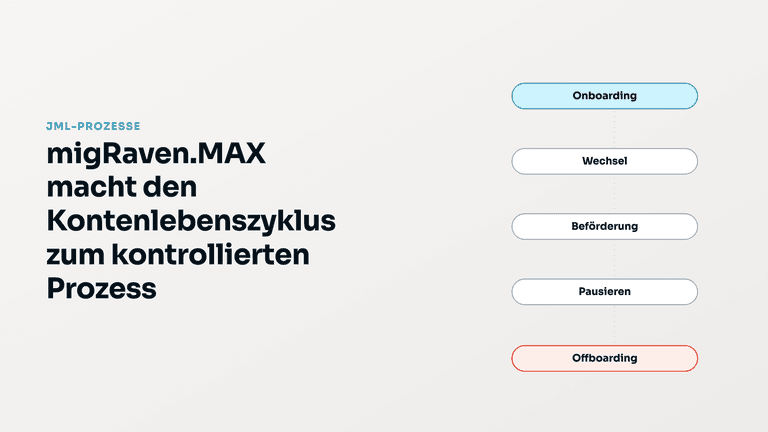
- Act: Actions run through workflows, owner approvals and audit trails.
- Verify: The implementation remains traceable and auditable.
This creates a closed security process: detect, understand, prioritize, act, verify.
Alarming: not every alert is equally important
Alarming is only valuable if it is precise. An alert that is triggered every day without context will eventually be ignored. An alert that reports a critical change in the right place, on the other hand, can be decisive.
migRaven MAX enables alerts for changes to critical groups, specific Windows security events or missing responsibilities, for example. However, the benefit lies not only in triggering the alert, but in putting it into context: MAX shows which relationships are affected, which permission paths arise and who is responsible from a business perspective.
Risk score: making the security posture measurable
One of the greatest challenges for IT management and the CISO is to present technical risks in an understandable and prioritized way.
migRaven MAX works with risk assessments that take the relationships in the graph into account: how strongly an object is connected, privileged rights, activity status, nesting depth and the number of effective permissions.
An account with few rights has to be assessed differently from an account that gains access to many sensitive resources via nested groups.
Risk scores and trend curves make cybersecurity manageable. Progress from Clean-up, recertification, owner assignment and permission reduction becomes measurable — including towards management, auditors and executive leadership.
Ownership: no security without responsibility
Cybersecurity rarely fails because of missing technology alone. It often fails because of missing responsibility.
The decisive questions
- Who is responsible for this group?
- Who confirms that this external account is still needed?
- Who is accountable for a service account that runs on production servers?
migRaven MAX therefore relies consistently on ownership. AD objects, accounts, groups, directories and other resources can be assigned to owners — rule-based, traceable and permanently verifiable.
This links technical analysis with organizational responsibility. It is precisely this link that is missing in many traditional security approaches.
Proactive cybersecurity means eliminating risks before the incident
Cybersecurity does not become proactive because a system raises alerts faster. It becomes proactive when risks are identified and eliminated before an attack can capitalize on them.
- orphaned user accounts
- forgotten external guests
- over-privileged accounts
- unclear service accounts
MAX makes these risks visible, explains their significance and helps to remove them in a controlled way. Critical changes run through workflows, owner approvals, justifications, audit trails and, where required, 4-eyes principles.
The paradigm shift: AI does not take over administration in an uncontrolled way. It makes risks understandable, prioritizes the need for action and enables people to decide faster and better.
Why AD, Entra ID and file servers have to be viewed together
Many companies today operate in hybrid structures. Active Directory is still the backbone of identity. Entra ID extends these identities into the cloud. Microsoft Teams and SharePoint create new data spaces. File servers still contain large volumes of business-critical information.
Security risks arise precisely at the transitions. A user starts in the local AD, is synchronized to Entra ID, gains access to Teams and SharePoint via groups and additionally holds NTFS permissions on the file server.
If each system is viewed in isolation, the overall picture remains hidden. migRaven MAX brings these perspectives together and shows which real access options arise from all connected systems.
AI, but controlled and traceable
Trust is crucial, particularly in a security context. An AI that simply makes claims is not enough. It has to make transparent what its assessment is based on.
migRaven MAX uses the knowledge graph as a reliable data basis. The AI works with structured information from the real customer environment. It can explain paths, show relationships, prioritize risks and generate reports.
At the same time, operational control remains with the company. Changes run through the platform, defined roles and approval processes.
Conclusion: cybersecurity needs context
The central challenge of modern IT security is not to collect even more individual data. The challenge is to understand the interrelationships.
Who has access? Why does this person have access? Which permissions arise indirectly? Which accounts are orphaned? Which changes are unusual? And who is responsible?
migRaven MAX answers these questions on the basis of a connected infrastructure and permission model. With AI, risk scores, alarming, security event monitoring, ownership and continuous analysis, reactive rule management becomes a proactive security strategy.
This makes MAX the security officer who never sleeps: It observes, understands, explains and prioritizes — so that risks become visible before they turn into an incident.
Webinar note
In the webinar “The security officer who never sleeps: how migRaven MAX detects risks before they turn into an incident” we show how companies move from reactive permission management to proactive cybersecurity with migRaven MAX.
You will learn how AI, alarming, risk scores, the owner principle and continuous infrastructure analysis work together — and why this approach represents real progress for IT security.