An information security officer is the controlling authority — vis-à-vis management, auditors, and regulators. What he lacks is a team. If he wants to know which deactivated accounts are still members of privileged groups, or who has access to financial data through which nesting, he has to ask the IT department. Whether he gets a reliable answer depends on their qualification and willingness. The alternative is external service providers who charge five-figure sums for a snapshot.
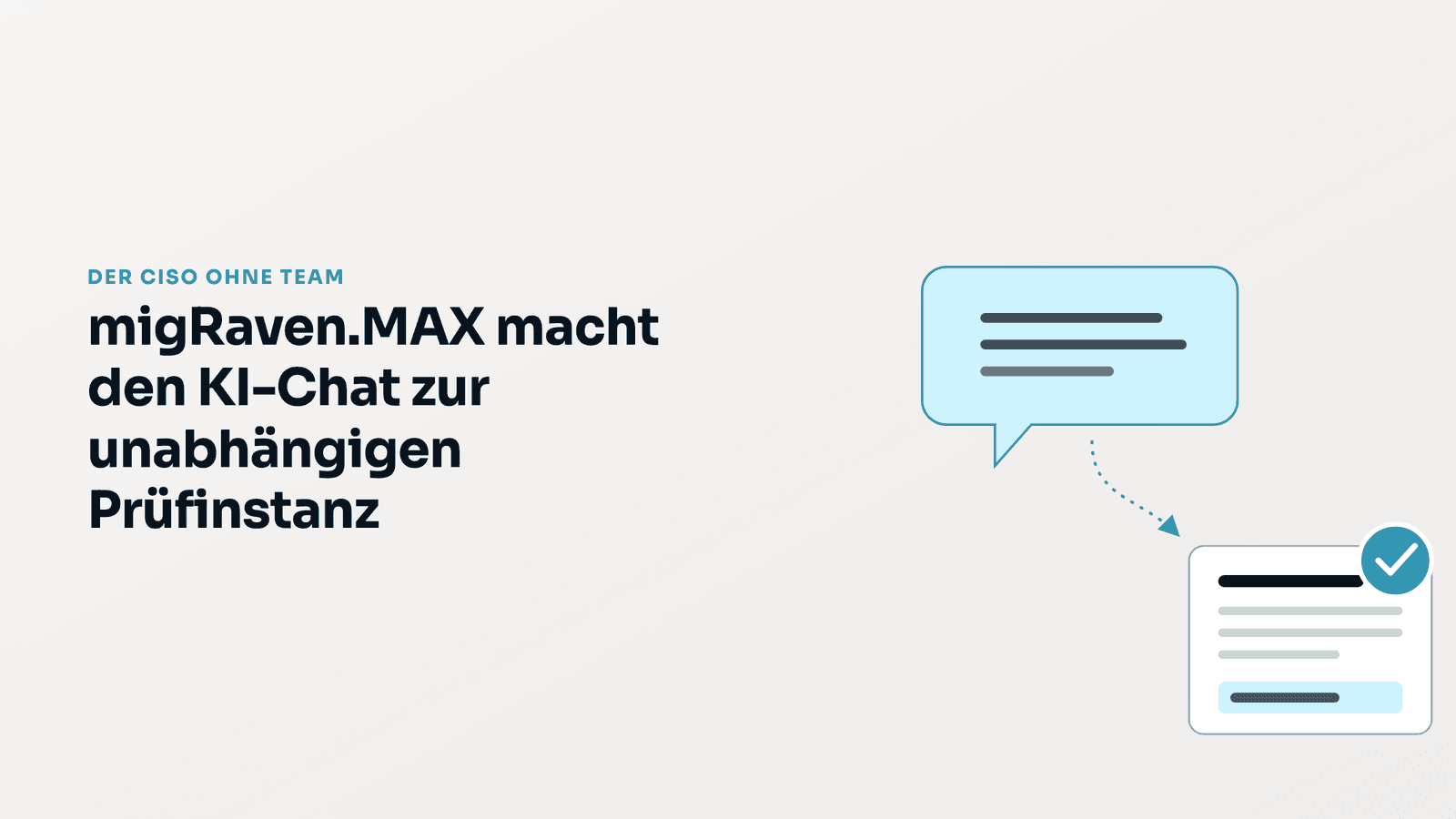
This is precisely the gap migRaven.MAX closes: the AI chat answers audit questions directly from the company's permissions graph, in natural language, read-only, with proof of how each figure was derived.
What used to apply
In most companies, an audit of the permissions landscape is an exercise in asking for favors. The auditor formulates questions, IT writes scripts, exports lists to Excel, and delivers a result after days or weeks that the auditor cannot verify himself. He does not know whether the query was complete, whether nested groups were taken into account, or whether the list is from Tuesday or from last month. And he is caught in a structural conflict of interest: the department whose work is being audited produces the evidence for the audit.
External auditors resolve the conflict, but at a price that limits an audit to once a year. What happens in between remains unobserved. The result is a control authority that formally bears responsibility but in practice can only report what others report to it.

What is new: the approach
migRaven.MAX builds a knowledge graph from Active Directory, Entra ID, Microsoft 365, file servers, and — if the agent runs on the domain controllers — from security events: accounts, groups, nestings, shares, permission inheritance, licenses, logons. The AI chat builds on this. A question such as "Which deactivated accounts are still members of privileged groups?" is translated into a graph query, executed, and answered. Three properties turn this into an audit tool rather than just a chatbot:
- Read-only, technically enforced. The query tool only allows read-only queries; write constructs are rejected before execution. The "Security Manager" role furthermore has no permission to modify accounts or groups. In the enforcement mode of AI access control, modifying tools are hidden for this role, and every attempt is logged. A CISO cannot break anything with MAX, and he does not have to promise anyone that he won't.
- Every answer comes with evidence. Behind every figure is the same query, which the auditor can inspect — as a chat response, evidence document, PDF or Word report, or CSV export.
- Investigation instead of an answer. For audit questions, MAX opts for an in-depth investigation: it creates an audit plan, works through the individual steps, stores the findings, and, on request, generates a report from them. The report distinguishes five states that an auditor must keep apart: inventory recorded, professionally assessed, finding, not assessable, not yet examined. MAX does not derive a security clearance from mere counts or from the absence of findings.

What an audit question sounds like
- "Create a security audit of my AD environment. For each finding: risk, affected objects, and a concrete recommendation." — Investigation with an audit plan covering accounts, groups, nestings, delegations, and privileged access, followed by a report from the stored evidence. For the annual audit and preparation for the external review.
- "Show me all the ways an account can effectively end up in 'Domain Admins,' including nested groups." — All paths into the Tier-0 groups; groups are identified by their security identifier, not by name, and are therefore also found in German-language domains.
- "Which deactivated accounts are still members of privileged groups?" — List of accounts with groups, membership path, and risk classification, for offboarding control.
- "Which activated accounts have not logged in for more than 180 days?" — Dormant accounts with permission scope, sortable by risk.
- "Which groups have no owner but more than 20 members?" — Accountability gaps, sorted by number of members, with a link to ownership assignment.
- "What has changed in the AD structure since the last scan?" — Changes to accounts, groups, and directory objects between two measurement points.
For the answer, the auditor chooses the format: chat response, evidence document, PDF or Word report, or CSV export for further processing. The CSV export bypasses the language model, running directly from the database into the file, with a checksum, so that no row can be invented or lost along the way.
Completing the picture: dashboards for auditors
Not every audit question needs to be asked. Three dashboards answer the recurring questions without a chat and give the auditor a starting point from which he can switch to the chat with one click — bound to exactly the object that caught his attention.
The Manager Dashboard shows structural complexity, account hygiene, and risk score as a trend. The NIS-2 Dashboard assesses three areas under § 30 BSIG — detection, evidence over time, change documentation — as sharp, partial, or blind; in a test environment with 7 out of 15 sharp detection rules, it honestly shows the area as "blind" instead of glossing it over. The Risk Dashboard combines structural risk from the permissions graph with observed behavior from the domain controller events, per account.
Why this matters
NIS-2 and the corresponding national regulations shift responsibility for information security to management, which delegates it to a person tasked with control. Control presupposes one's own view. A control authority that must order every finding from the audited department is not a control authority, but a distribution list. The chat changes the balance of power without bypassing IT: it delivers the data once, via the scans. After that, the auditor can ask as often as he likes, in his own words, with an immediate answer and with the evidence an auditor wants to see.
Economically, the audit shifts from an annual snapshot to ongoing control. The questions an external auditor asks once for a five-figure fee, the auditor can ask every month and compare the answers between two measurement points. The service provider does not become superfluous, but is given a different task: it audits the method, not the raw data anymore.
Our position
We thought long and hard about whether audit questions should be put to an AI at all. The obvious concern is justified: a language model that cheerfully reports "no anomalies" because its query was cut off prematurely is more dangerous than no tool at all. That is why we did not optimize MAX to sound convincing, but rather to say "not assessed" instead of inventing something plausible. An audit tool that never says no is not an audit tool. And we built it so that a CISO cannot change anything with it — not because we distrust him, but because the separation of operations and control is the precondition for his findings to be worth anything.
Three design decisions
Why a chat and not another reporting page?Because an auditor's questions are unpredictable. A report generator answers the twenty questions its manufacturer envisioned. An auditor asks the twenty-first, in his own words, with the knowledge from the last conversation with the department.
Why a graph and not lists?Because dangerous rights are rarely assigned directly. They arise through the fourth nesting level, through an inherited share, through an account that links two groups. Lists show what someone has. The graph shows where it comes from — that is exactly the question an auditor asks.
And why the dashboards on top of that?Because control requires routine. Nobody should have to formulate the question "Has it improved since the last audit?" anew every month.
Prerequisites
The AI chat is part of migRaven.MAX and can be accessed via the "Max AI" button on every page as well as via the assistant's full-screen view. It requires a configured model provider; the administrator determines the level of AI access control. The NIS-2 dashboard, the risk dashboard and the change analysis are enabled as the NIS-2 package for administrators, risk, security and clean-up managers.